
Symposium objectives
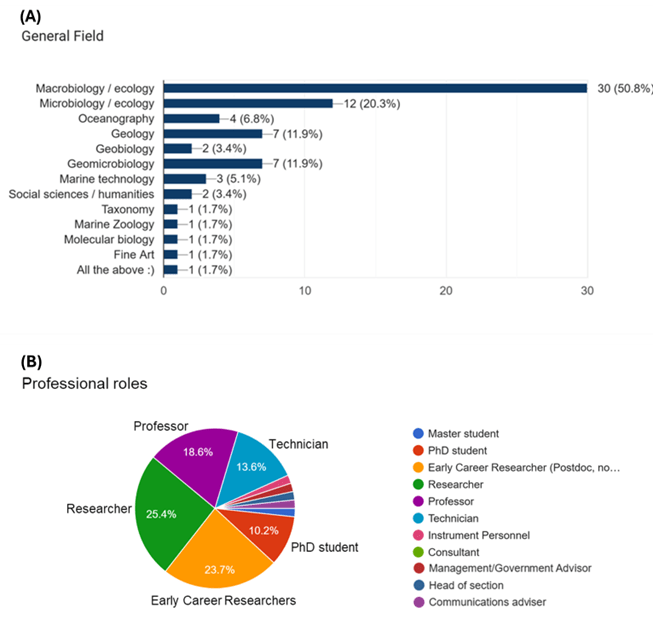
The 2nd Bergen Bathysphere Science Symposium was held on 11-12 November 2024 at the Scandic Voss Hotel, Voss, Norway. Themed “Past, Present, and Future of Nordic Deep-Sea Science,” the symposium brought together 57 professionals, macro- and microbiologists, geologists, oceanographers, marine technologists, and more (Fig.1A), to discuss the current state and future directions of Nordic deep-sea research. It served as a platform and provided a physical space for knowledge exchange, networking, and collaboration among professionals from diverse roles (Fig. 1B) and institutions across Norwegian cities and beyond (Table 1). The symposium aimed to foster interdisciplinary dialogue on the current state, future directions, and knowledge needs in Nordic deep-sea research. Emphasizing networking and collaboration, it provided a physical space for professionals in deep-sea science to connect.
| Institute | Affiliated Departments and Research Units | Location |
| Norway | ||
| University of Bergen | Department of Biological Sciences, Department of Earth Science, Centre for Deep Sea Research, University Museum, Michael Sars Centre, Centre for the Study of the Sciences and the Humanities, Department of Social Anthropology | Bergen |
| NORCE | Molecular Ecology and Paleogenomics | Bergen |
| Institute of Marine Research | Benthic communities and benthic resources research groups | Bergen, Tromsø |
| UiT The Arctic University of Norway | Department of Arctic and Marine Biology, Department of Geoscience | Tromsø |
| University of Oslo | Department of Bioscience | Oslo |
| Akvaplan-Niva | – | Tromsø |
| Geological Survey of Norway | – | |
| Norwegian Offshore Directorate | – | |
| Outside of Norway | ||
| NIOZ Royal Netherlands Institute for Sea Research | Department of Ocean Systems | Texel, The Netherlands |
| Plymouth Marine Laboratory and the University of Plymouth | – Faculty of Science and Engineering | Plymouth, UK |
| Senckenberg Research Institute and Natural History Museum | – | Frankfurt, Germany |
| Kiel University | Institute for General Microbiology | Kiel, Germany |
Session Structure and Summaries
The symposium program included oral and poster presentations, group discussions, and social activities (see detailed program here https://bathysphere.no/seminar-2024-programme/).
Scientific components
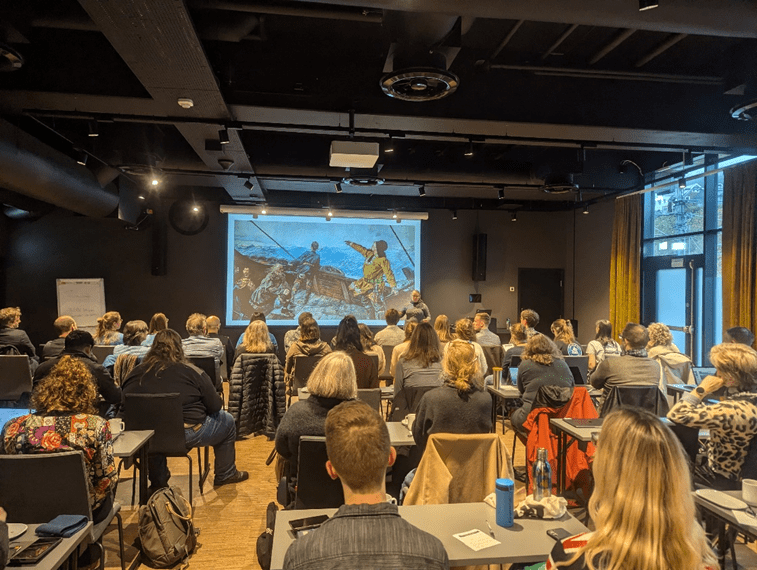
Over the two-day conference, we hosted 5 keynote talks, 5 regular talks, 20 speed talks, and a selection of poster presentations (Fig.2). The symposium was structured around three thematic sessions:
- Past: Explored the historical development of deep-sea research in the Nordic Seas, highlighting other topics, such as baseline studies of deep-sea biodiversity, long-term geological, biological, and environmental data collection, and seafloor mapping.
- Present: Addressed current knowledge status of Nordic deep sea and ongoing projects, including assessments of seabed mineral resources, the impact of human activities on deep-sea ecosystems, the interplay between science and policy, and knowledge of chemosynthesis-based ecosystems.
- Future: Focused programs and strategies for enhancing collaboration in deep-sea science and innovative approaches to data collection and processing in the deep sea.
These sessions provided a comprehensive overview of the historical context, current advancements, and future directions in Nordic deep-sea research.
Interactive Components
Beyond scientific presentations, the symposium included interactive discussions designed to encourage collaboration and problem-solving on the following topics:
- The Role of Scientists in Deep-Sea Mining – communication between scientists, the public, and policymakers regarding knowledge status on deep sea and environmental impacts related to deep-sea mining, potential ways forward to provide the knowledge needed, and to enhance communication strategies.
- Discussion tables involving brainstorming on selected topics (incl., Designing a cruise that has unlimited money and uses each of your team members’ main skill sets, Deep-sea mining, Global collaboration and standardization, AI, and Accessibility (or colonialism) of deep-sea science).
- Coordination of a National Deep-Sea Initiative – Discussing the need for a national Bathysphere community, its potential benefits, and possible approaches for establishing and coordinating this initiative.
- Organizing the 2028 Deep-Sea Biology Society Conference in Bergen – planning efforts to bring the international deep-sea research community to Norway.
Social activities
Social activities encouraged interaction and informal networking among participants. Structured activities, including icebreakers such as ‘People Bingo’ and the ‘Deep-Sea Teamwork Catch Phrase’ game, as well as a group walk, helped create a friendly and engaging atmosphere. Mealtimes and coffee breaks provided a relaxed setting for attendees to connect and exchange ideas.
Feedback and Outcomes
The symposium received highly positive feedback from the attendees. Participants appreciated the balance between formal sessions and informal networking, the discussions on pressing topics, and the interdisciplinary approach. Based on the Slido poll, the most frequently mentioned impressions about the 2-day of symposium included “Very well-organized,” “Interesting conversations,” “Inspiring,” “Much needed,” and “New contacts/Network,” among others (Fig. 3).

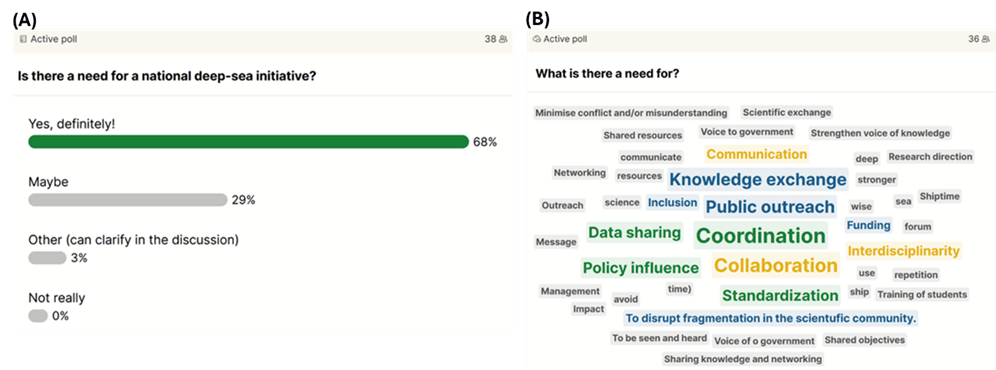
Most attendees agreed on the necessity of establishing a national deep-sea initiative, emphasizing the need for knowledge exchange, coordination, collaboration, public outreach, standardization, policy influence, interdisciplinarity, and sharing of resources (data, ship time, funding) (Fig. 4 A, B).
Concluding Remarks
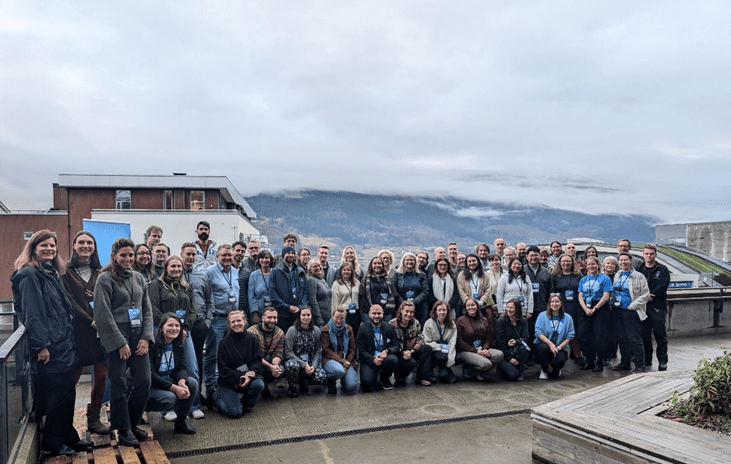
The Symposium achieved its goal of providing a physical place to connect researchers, exchange insights on ongoing projects, and discuss emerging issues in Nordic and Arctic deep-sea science.We strengthened our bonds and engagement on a local level while expanding our network by welcoming deep-sea scientists from across and outside of Norway (Fig. 5). Future efforts will likely focus on establishing a formalized Norwegian network. Communication among participants and other Bergen Bathysphere members will continue through the mailing list and Discord channel, alongside the organization of annual meetings, workshops, and seminars to maintain engagement and collaboration.
The event was organized by the Bergen Bathysphere Organizing Committee, including Heidi Meyer (IMR/HI), Hasan Arsın (UiB), Irina Zhulay (UiB), Jon Hestetun (NORCE), Petra Hribovšek (UiB), and Rebecca Ross (IMR/HI). The Bergen Bathysphere is a voluntary network of Bergen-based deep-sea scientists and professionals dedicated to enhancing collaboration and knowledge-sharing across local institutes. For more information about the Bergen Bathysphere community and the event, please visit: bathysphere.no and 2nd Bergen Bathysphere Science Symposium 2024.
Financial support
The event was supported by L Meltzers Høyskolefond, NORCE, and Deep Sea Center, UiB.
 bathysphere.no